Explore a maze populated by the natural enemy of the wizard… Ninjas!
Learn and perform hand signs to cast well-timed spells against foes who would prevent your escape.
In this action stealth spell-slinger, it’s you, your wits, and the hand signs you make, that’ll decide your fate.
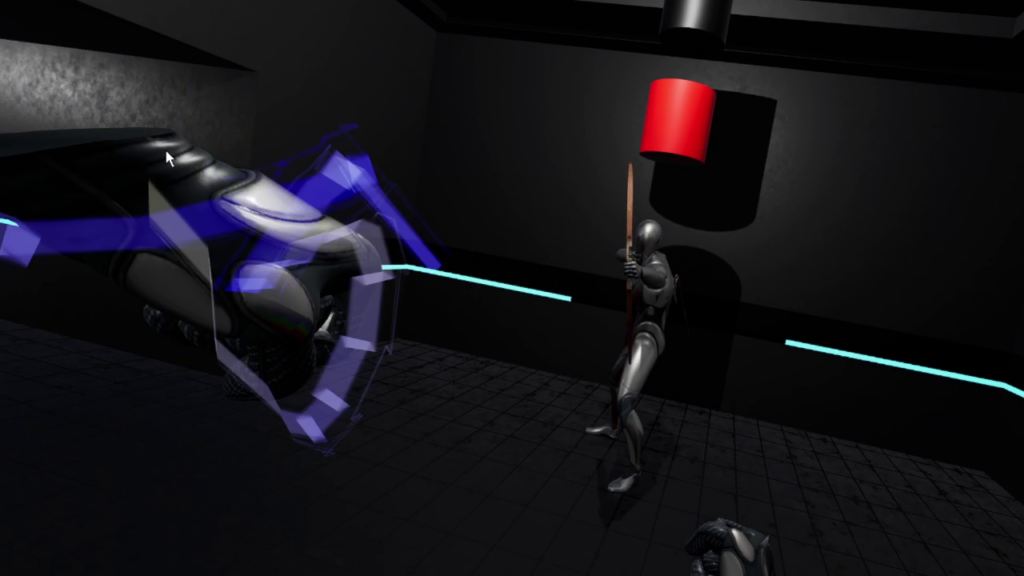
Peril awaits around every corner; each sentient ninja ever ready to assemble a hoard. Stay hidden and progress carefully but always be prepared to draw upon your innate powers. Every wise wizard knows to carefully consider all options across the 5 primal elements. A well-timed attack with a lightning blade or a tactical escape behind an earth wall, can be what determines your continued existence.
Tackling this ambitious game was made possible by a team of highly skilled individuals all bringing multiple talents. Key building blocks such as: the VR Player controller, AI Behaviour and VFX could be built in parallel and brought together into individual components, where sprints and scrums guided our practice as we worked towards incremental releases.
Key Technical Innovations include:
- A relative distance mechanic applied to the hands during the grabbing animation causes them to flex against objects as individual fingers bend away from and around topology. Execution happens via splines with a controller that drives the animation. Most prominently this mechanic can be seen executed in “Half Life Alyx”.
- Our hand sign system consists of a detection and recognition component that delivers the player a realised kinesthetic gameplay experience for unrivalled immersion.
- The detection component records the relative physical orientation of the hands as well as which fingers the player holds onto the controller with. Specific combinations of both are recognised as correct hand signs and visual cues (in the form of elemental effects) indicate the players success.
- By chaining together a specific sequence of hand signs, the recognition component grants the player the ability to cast the corresponding spell.
- The AI utilises the powerful behaviour tree system provided by the Unreal Engine. This facilitates creating intelligent reactive behaviours for NPCs.
- NPCs have sight and hearing making them able to hone in on the broad location of and investigate disturbances.
- Upon encountering the player, enemy AI can call for backup from anyone in range before pressing an assault.
- Access to a ranged and melee option allows NPCs to make dynamic decisions dependent on the combat scenario.
- Unreal Engine’s new Niagara particle system provides engaging visuals to complement the games spells
- A platform agnostic approach to controls allows players to use any headset and controller combination without sacrificing the additional features newer tech grants (in this case the valve index controllers the game was specifically designed for).
As a long time player of VR I had been frustrated by the fragmented VR market, gameplay and overall experience. Games were few and far between, varied in quality and were seemingly struggling to tailor the experience to the new-ish platform. I saw an opportunity to reduce barriers to immersive gameplay by moving away from traditional button based inputs, instead leveraging players real life physical actions to interact with the game.
Innovative and unique concepts have been brought together into a demo. As a ‘toy’ gameplay offers a coherent and fresh experience for VR. All core technical elements of the original design were executed and evolved into an illustrative case study in how to increase immersion and reduce the barrier between interface and experience.